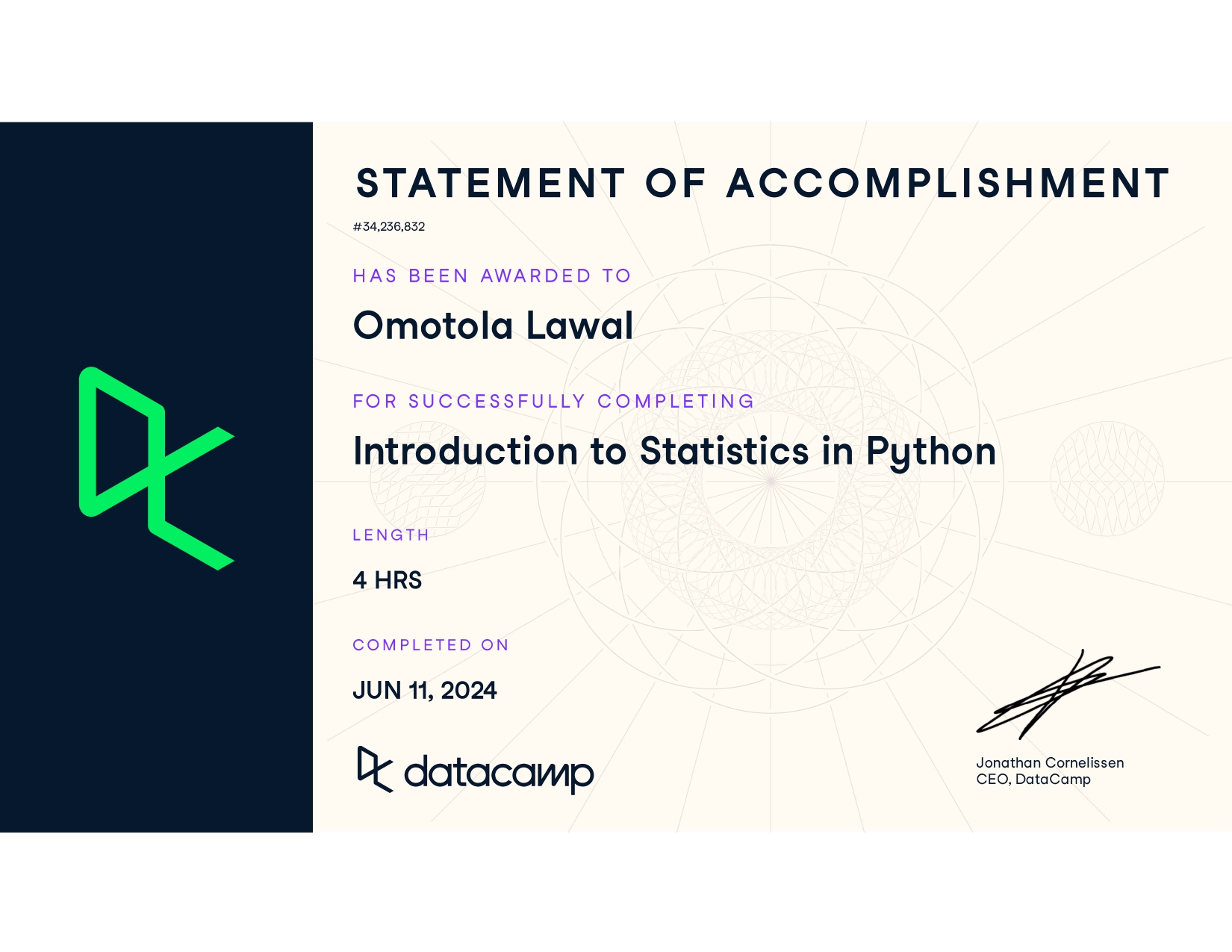
Completing the Introduction to Statistics in Python course has strengthened my ability to summarize, analyze, and interpret data using Python. Along the way, I explored key concepts that form the foundation of statistical thinking. Below is a summary of what I learned:
1. Data Types and Measures of Center
- Differentiated between numeric (discrete, continuous) and categorical (nominal, ordinal) data.
- Learned how to summarize data with mean, median, and mode.
- Discovered how outliers and skewness affect the choice of summary statistic.
- Practiced using histograms to visualize sleep patterns in mammals.
2. Measures of Dispersion
- Explored ways to describe how spread out data is, including:
- Variance and Standard Deviation
- Mean Absolute Deviation (MAD)
- Quantiles, Quartiles, and Interquartile Range (IQR)
- Variance and Standard Deviation
- Used boxplots to detect outliers and measure spread.
3. Probability and Randomness
- Understood concepts of independent vs. dependent events.
- Practiced sampling from datasets with and without replacement.
- Applied random seeds for reproducibility.
- Learned to calculate probabilities using probability distributions.
4. Probability Distributions
- Worked with discrete distributions like rolling dice and visualizing probability areas.
- Learned the binomial distribution to model binary events (success/failure).
- Applied continuous distributions such as:
- Uniform Distribution
- Normal Distribution
- Poisson Distribution
- Exponential and Student’s t-distribution
- Uniform Distribution
- Practiced simulating real-world scenarios (e.g., waiting times, coin flips, and sales deals).
5. The Central Limit Theorem (CLT)
- Explored how sample means approximate a normal distribution, regardless of population shape.
- Understood why larger sample sizes improve accuracy.
- Applied CLT to both numerical data and proportions.
6. Correlation
- Learned how to measure and interpret relationships between two variables using the correlation coefficient.
- Understood strength (magnitude) and direction (sign) of relationships.
- Visualized correlations with scatterplots and trendlines.
- Practiced calculating correlations using Python libraries.
- Noted that correlation ≠ causation and explored confounding variables.
7. Experimental Design
- Distinguished between observational studies and controlled experiments.
- Learned the “gold standard” principles of experiments: randomization, control groups, and replicability.
- Understood differences between longitudinal and cross-sectional studies.
Key Takeaways
- Gained practical skills in descriptive statistics, probability, and distributions.
- Learned how to model uncertainty and variability with statistical tools.
- Built intuition for how statistics informs decision-making in real-world contexts.
This course laid a strong foundation for my journey into data analysis and statistical modeling with Python.
Check here for details.